

Class 4: Comparing examples of Online storytelling.
- Tom Hogan

- Nov 27, 2019
- 2 min read
Updated: Dec 14, 2019
In today's class we were asked to choose an example of online storytelling from a list curated by John Stearns and compare and contrast this with a story which was chosen by someone else.
I chose The making of a Narco-terrorist, published by Propublica while my classmate Will chose The Drone papers published by The Intercept.
The two publications told two different stories in two different ways but both fall under the larger umbrella of stories which aim to hold governments to account for their (shady and unethical) actions.
My story outlines 5 seperate cases which lead to convictions of Narco-terrorism by the United States' DEA (Drug Enforcement Agency). In all cases the convictions were the result of 'sting operations' in which undercover DEA agent organised a deal of weapons or drugs to the USA and then arrested and extradited the unwilling participant.
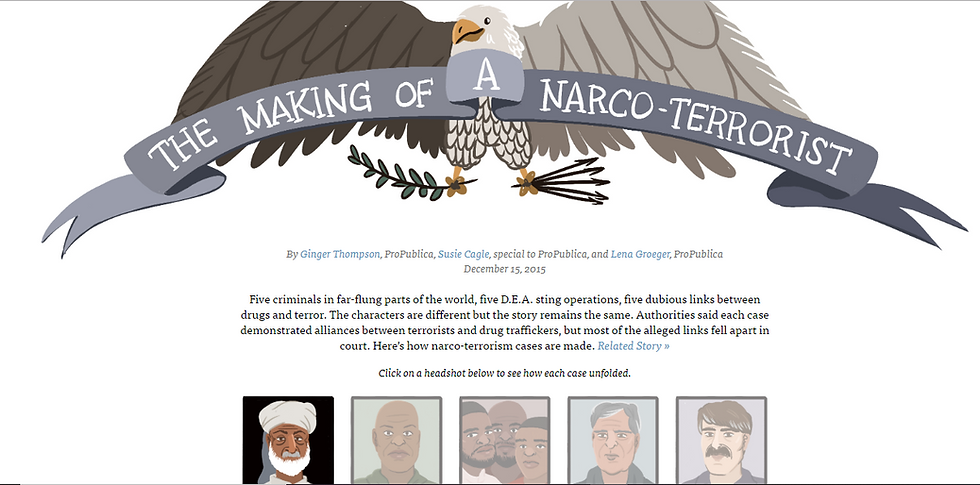
The stories are told in a simple but attractive comic style and all stories share a common layout.



The stories aim to raise the question, is the DEA stopping terror threats or staging them in order to prolong their involvement in foreign drug wars in the name or "narco-terrorism"? I'm interested in why the authors chose to go with the comic book style. I initially thought that it was in order to engage with a younger audience but now I believe they may have used this simplistic visual style in order to make a rather complex topic more digestible for the average reader. The style they have chosen makes clear the structure of the DEA's approach to each 'sting' and this a story which could get weighed down by military jargon if it was told in a long format.
Will's story of the drone papers follows such a format and is far more complex than mine.

It consists of a number of stories breaking down the US' use of drone strikes for the purpose of assassinations outside of active warzones in Somalia and Afghanistan. Once again it is a story aimed at increasing government accountability and transparency over unethical foreign policy. The purpose behind this is to enact some kind of change through the disemination of classified information to the American Public. Information which was obtained via whistleblowers.
Whether either one of these stories contributes to any long term change is yet to be seen but both a certainly engaging examples of online multi-media storytelling, hopefully they amount to something more than that.
-T
Thompson, Ginger et al . 2015, The making of a narco-terrorist. Propublica. Viewed December 11 2019. https://projects.propublica.org/graphics/narco
The intercept. 2015. The Drone Papers. The intercept. Viewed 11 December 2019. https://theintercept.com/drone-papers/the-assassination-complex/


Comments